Monday, February 23, 2009

LaHood in Driver Seat, Transit Tax Proposal Cited


Shortly after Secretary of Transportation Roy LaHood raised the idea of a transportation tax based on mileage, rather than gas, the idea was curbed in both a written statement from the department and by White House spokesman Robert Gibbs. LaHood's proposal, which would have placed GPS devices in cars, suggested people could be taxed by how much they drive, rather than how much gas they purchase. LaHood said that the plan, which could have raised additional funds for infrastructure, was something "we should look at."

The Department of Transportation issued a statement that addressed LaHood's idea: "The policy of taxing motorists based on how many miles they have traveled is not and will not be Obama administration policy." The idea of a mileage tax is still being floated around by a few states—namely, Idaho, Rhode Island and North Carolina. Oregon has actually run a pilot program, and found the program to be viable.

This proposed tax would have environmental implications–some good, some bad. When people buy more efficient vehicles, they use less gas, which is a good thing. Still, they're driving as much as they did, and their cars have the same effect on the road, so the government doesn't get as much revenue from these drivers to fix our highways and bridges. As more people begin driving hybrids and using less fuel, this will become a greater problem.

Meanwhile, green bloggers have pointed out that presently, a mileage tax would punish them for consuming less gas, and take away the incentive for others to purchase hybrids. Morgan Clendaniel of Good offers a solution that would be a weight-per-mile tax, which would reward drivers of lighter vehicles (like the Prius) which presumably do less damage to the road. The problem with all of these ideas, though, is that they still require a GPS to be installed in each car. This is widely considered to be a privacy concern.

Where do we go from here? The taxman cometh, but, thanks to enforced GPS tracking, we'll see him coming from a mile away.

Real Estate: Albert, Texas, Spotted on the Sale Rack


The economy may have fallen off the roof and broken its back, making larger investments (for example, buying property) a bit precarious. But if you've ever had aspirations of owning, say, your own town, have we found a blue-light special for you. Nestled just a quick jaunt North from San Antonio, the ghost town of Albert, Texas is up for grabs at $883,000.

According to a CBS report in 2007, the town's owner Bobby Cave put the town on the market for a sum of $2.5 million (he paid $216,000 for it). That was then; this is now.

Amenities: An 85-year-old dance hall; an icehouse and beer garden; a creek; an historic limestone schoolhouse (the town rumor is that President Lyndon B. Johnson attended in 1920–but the rumor's getting harder to corroborate with subsequent population decline); pecan and peach orchards; a three-bedroom, two-bathroom home; and, according to Albert's Web site, "ample parking."

Albert once bustled with 50 residents in 1925. By 2000, the populace reduced by 50%. When Cave came along in 2003, it was nearly deserted. By October of 2007, after putting hundreds of thousands of dollars into the town, he was ready to move on. Adhering to the Texas state census, a dusty sign that reads "Population: 4" greets visitors upon entry. 

In a related story, an island (yes, an island) is also up for grabs to a lucky bidder. The seller is Brian Silvernail, a commercial real estate developer, property auctioneer, and technology enthusiast (he named his three sons Emerson, Ethan, and Elliot so that he can refer to them as his e-boys).  It seems that he too has grown tired of his privately owned (and water-ensconced) land mass, which is available for perusal and–he hopes–purchase.

Airlines Seek In-flight Luxuries Great and Small


Flying the friendly skies has become a nickel-and-dime industry. The new era of air travel brings fees for everything from checked baggage to traveling with a child. But sometimes we’re getting what we pay for when those service charges accumulate. The range of “extras” varies, of course, but with fewer trips being booked, airlines are quickly distinguishing themselves in niche markets.

Starting March 1, US Airways will resume serving complimentary sodas, juices, tea, coffee, and water. Last August the airline started charging $2 for all non-alcoholic beverages. US Airways CEO Doug Parker issued a letter to his employees stating, "We know customers don't buy an airline ticket based on whether or not they will get a free soda onboard, but with US Airways being the only large network carrier to charge for drinks, we are at a disadvantage."

In higher-end airfare, Gulf Air, the national carrier of Bahrain, recently signed an agreement to lease four new Boeing 777 ER aircraft as part of the airline’s re-fleeting and product-enhancement strategy. The aircraft are embellished with an artfully appointed interior and a number of luxurious amenities, including private suites with bespoke furnishing and a fully flat bed complete with a personal wardrobe.

Business class is decked in herringbone designs, beds with 180 degree recline capability, and Egyptian cotton linens.

Gulf Air deputy CEO Ismail Karimi issued his own statement recently: “As the national carrier of the kingdom, we are constantly looking at opportunities, where we can offer enhanced products and services for our customers. Ultimately, we want Gulf Air to be the airline of choice.”

As airlines compete with one another over who rules the most sky miles, it's becoming clear that cost-cutting ticket prices has made little impact. Instead, trip packages are considered the defining factor: more bang for (more) bucks.

Does Raising Children Bilingual Make a Difference?


Season two of the popular Bravo television series "The Real Housewives of New York City" is in full swing, and with it, the catfights, the social-climbing, and the controversies are back to entertain us. One of said housewives, Alex McCord (along with her fashionista husband Simon van Kempen) remains determined to invest heavily in her children’s education, starting with raising the toddlers bilingual. To do so, McCord and van Kempen employ a French-speaking au pair (who claims a $30,000 per year salary) and insist that sons Francois and Johan interact with the world strictly en francais. The question is, will this make a difference in their learning?

Christina Bosemark, founder of the Multilingual Children's Association, co-founder of the Scandinavian immersion school in San Francisco, and mother of two trilingual daughters, recently wrote an article titled "Raising Bilingual Children: The First Five Steps to Success.” In it, she suggests that previous generations of parents believed the route to raising a polyglot tot was “via an exorbitantly priced Swiss boarding school. Luckily, such elitism has been thrown out the window, and now parents raise multilingual children themselves,” she writes.

Bosemark’s up-to-date solution? "Just talk to them."

Her research suggests that a child needs to be exposed to a language 30% of his or her waking time to actively speak it. Since waking time is a finite quantity, so, too, is language acquisition.

According to Bosemark, one effective learning plan requires one parent to always speak to the child in the foreign language, preferably the parent who spends the most time as the primary speaker. Otherwise, building a bilingual household means investing in an outside (but indoor) source like a bilingual nanny or an au pair. McCord and van Kempen appear to have earned Bosemark’s endorsement.

Immersion, she maintains, is simpler than you’d think. Providing your child books, music, movies, and toys in your minority language are the most obvious ways to boost international exposure. It’s a long-term commitment, Bosemark asserts, but one that will pay off. It’s worked for Madonna and Antonio Banderas, right? 

Not so fast.

Bonnie Gray of the Silicon Valley Moms Blog (and owner of luxury shopping cart and high-chair seat cover company Just Peachy Baby) begs to differ. A first-generation Asian American growing up in Northern California during the 1970s, she posted about her own experiences juggling multiple languages in the house.

“I was always encouraged to speak and learn English well,” she states. “When I became an adult, it was rare to be asked whether I spoke a second language. Even during the few times I've tried to speak Chinese to some of my overseas born co-workers, they would let me know that they preferred that I speak English with them.”

Gray suggests that without total immersion, the child can get more confused by learning a second language at an early age. She also adds that children can become frustrated, and turned-off, by the prospect of bilingualism if it isn’t integrated holistically (or in her opinion, impractically) into their lives.

“People remind me that being fluent in Chinese would give [my son] a competitive edge in the working world, given our global economy,” she writes. “Some have even told me that my son will grow up and resent me for not teaching it to him when he was young.”

Instead, Gray asserts, try teaching your children about various cultures and ethnicities, so that they might gain some insight and awareness of the world around them. The same immersive tools can be used, from books and movies, to posters and foreign foods.

Both Bosemark and Gray agree that promoting an awareness of other cultures is crucial in a child’s development. And with awareness instilled, language is a logical next step.

Entrepreneur Report: TOMS Shoes Founder Blake Mycoskie Sets Example


Sometimes doing well means doing good.

Blake Mycoskie is the founder and CEO of TOMS Shoes, the top-selling casual shoe brand whose profits are more than $10 million since the first pair of madras slip-ons (called Alpargatas) was sold in 2006. Always an entrepreneur (he sold cookies on a local golf course as a teen), by age thirty Mycoskie had launched five successful businesses. TOMS is the one closest to his heart because it combines his passion for innovation and philanthropy, a business trend that he believes is the next big thing.

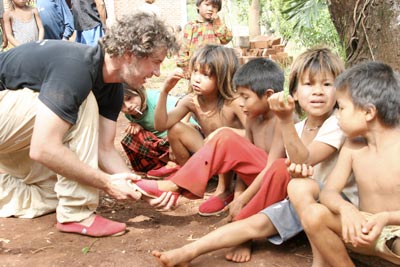
While on vacation in 2006, Mycoskie befriended the children of an Argentine village. He watched as they walked miles to retrieve fresh water for their families in their bare feet. His company was founded on a simple but mighty premise: for every pair of shoes purchased, he would donate a pair to a child in need. Since May of that year, TOMS has hand-delivered more than 300,000 pairs of shoes to children without. A documentary detailed one of his recent “shoe drops” in South Africa and premiered to acclaim at the 2008 Tribeca Film Festival. He’s been featured in Vogue, The New York Times, Time, and O, was honored by the Smithsonian Institute, and was tapped by fashion icon Ralph Lauren to design shoes for Lauren’s trendy Rugby line. More brands are following suit and asking to partner with TOMS to clothe the needy. Fashion and philanthropy are contagious, it would seem.

When he’s home in Los Angeles (in a matter of speaking—he lives on a $340,000 45-foot boat), Mycoskie tours the country speaking publically about the key to his success: people are inspired to buy a product that promotes—and enacts—charity and good will.

Is this the frontier of new business?